
How to learn the splits: front and middle splits at any adult age
The splits aren't talent, they're systematic mobility work. The two variations, the key stretches and a clear plan – from the Strive Up skill tree.
Contents
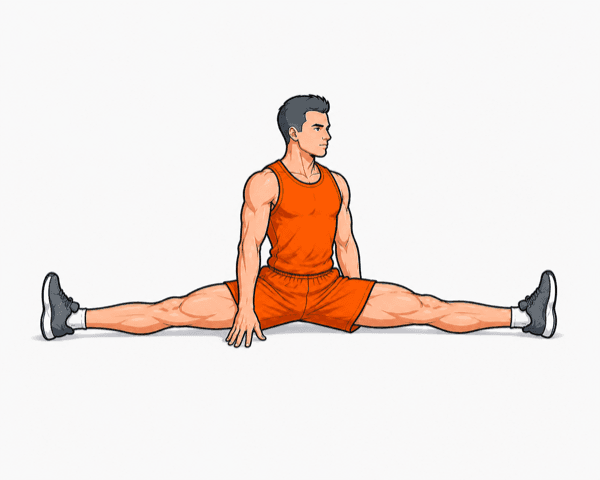
"You can't learn the splits as an adult." – one of the most persistent myths in fitness. The truth: it takes you longer than it takes a child, but with systematic work the splits are achievable in 6–12 months for most people.
What the splits actually require
The splits are neither a trick nor pure genetics. They are a combination of mobility, neuromuscular safety and patience. The muscles do lengthen – but your nervous system has to learn to relax in extreme end ranges instead of protecting you.
Areas trained: hip flexors, hamstrings, adductors and internal hip rotation.
Front vs. middle splits
Front splits: one leg forward, one back. Mainly stretches the hip flexors (of the rear leg) and the hamstrings (of the front leg).
Middle splits: both legs out to the sides. Mainly stretches the adductors. For most people considerably harder than the front splits because the geometry of the hip joint is involved differently.
Your path to the splits
Your path to the full splits
The splits aren't one skill but two: front splits (one leg forward, one back) and middle splits (both legs to the sides). The path from the Strive Up skill tree.
The most important drills
- Deep lunge with knee down: deep lunge with the rear knee on the floor. Actively press the hips down. 2 × 60 seconds per side.
- Pancake stretch: seated with the legs spread as wide as possible, torso forward. Preparation for the middle splits.
- Frog stretch: knees and hips at 90°, spread wide, upper body on your forearms. Adductor stretch.
- Couch stretch: rear leg propped up against the wall, front leg in a lunge. Maximum hip flexor stretch.
- PNF / contract-relax: in the stretched position, contract the muscle against resistance for 5 seconds, then move deeper into the stretch. Speeds progress up considerably.
Common mistakes
- Ignoring the pain threshold: you don't learn the splits through pain. Sharp pain means back off. Mobility is patient work.
- Only static stretching: dynamic drills (leg swings, cossack squats) plus static holds are the best mix.
- No warm-up: never go into an end range cold. Ten minutes of easy warm-up before every mobility session.
- Inconsistency: mobility progress is highly dose-dependent. Ten minutes five times a week beats sixty minutes once a week.
Training plan
Daily (10–15 min): lunge + couch stretch + frog stretch – 2 × 60 seconds per side each
3 × per week (30 min): the full routine including PNF work and active drills (leg swings, cossack squats)
1 × per week: splits test. Use yoga blocks for support. Take a photo to compare progress.
Track it with Strive Up
In Strive Up you track the splits by the height of the block support. From "yoga block on its end" via "block flat" to "floor" – every centimetre of progress becomes visible. Mobility is slow, but it is very measurable.
Train smarter with Strive Up
Track your training, use the EMOM timer, follow your PRs and discover your personal skill roadmap – for free.


Related articles
How to learn the muscle up: the complete progression guide
From the dead hang to your first clean muscle up: prerequisites, every lead-up stage, common mistakes and a clear plan that actually gets you to the king of bar skills.
How to do pull-ups properly: technique, mistakes & progression
From the dead hang via scapula and band pull-ups to a clean full-range rep: technique, common mistakes and the complete progression ladder from the Strive Up skill tree.
How to do dips properly: from the bench dip to muscle-up ready
The complete dip progression: bench, parallel bars, straight bar, russian. Technique, common mistakes and a training plan – straight from the Strive Up skill tree.