
How to learn the muscle up: the complete progression guide
From the dead hang to your first clean muscle up: prerequisites, every lead-up stage, common mistakes and a clear plan that actually gets you to the king of bar skills.
Contents
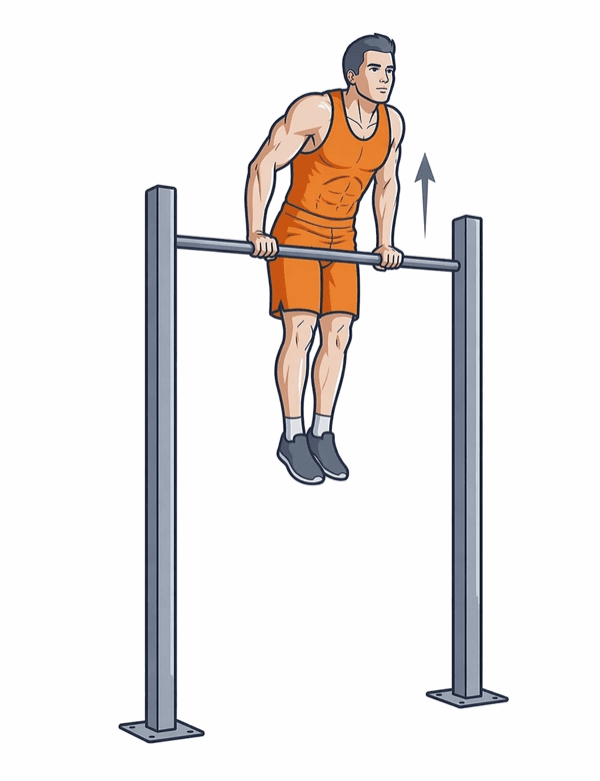
The muscle up is one of the most iconic movements in calisthenics: from a hang, in one flowing motion, over the bar into the support – no swing, pure strength. It combines explosive pulling power with the transition into a pressing phase and is considered the gateway to advanced skills such as the front lever and planche push-ups.
The catch: no tutorial turns an athlete with five pull-ups into a muscle-up athlete overnight. What does exist is a clear progression path – and that's exactly what you get here.
What is a muscle up?
The muscle up has three phases: an explosive pull-up, the transition (moving from a pulling grip to a support grip over the bar) and the dip out of the support. Muscles involved: lats, biceps, triceps, chest, front delts and core.
Why the muscle up is so hard
The decisive point isn't the pull – it's the transition. At the very top of the pull you have a fraction of a second to get your hands over the bar and press into the support. Too little explosive power or too little dip control and you end up stuck with your sternum against the bar.
Prerequisites
Before you work seriously on the muscle up you should own these three skills:
- Pull-ups (full range) – 10 clean reps with the chest touching the bar
- Straight bar dips – 10 reps on a straight bar (not on parallel bars)
- Pull over – 5 reps, i.e. rotating from the hang over the bar
These three goals aren't there for their own sake – they cover exactly the weak points where most muscle-up attempts fail: too little pulling strength in the upper range, too little pressing strength in the support position and too little understanding of the rotational movement.
Your path to the muscle up
Your path to the muscle up
The skill tree exactly as it appears in the Strive Up app: a pull-up progression chain plus five individual prerequisites, all feeding into the muscle up.
The stages explained
1. Dead hang (1:00)
Hanging passively from the bar with straight arms. It sounds simple, but it's the base for grip strength and shoulder stability – without it you'll lose the bar somewhere in the upper pull of the muscle up.
2. Pull-ups: scapula → band → full range
The pulling path takes you to the full pull-up step by step. Scapula pull-ups train the shoulder blade musculature as a lead-in. Band pull-ups reduce your bodyweight and make clean reps possible. Only once you manage 10 strict pull-ups do you move to full range – chest to the bar. That upper range decides later whether you have enough height for the transition.
3. Dips: bench → parallel bars → straight bar → russian
In parallel you build pressing strength. Bench dips are the entry point, parallel bar dips get you to 20 clean reps. Straight bar dips are essential: they force your wrists and core into exactly the position you land in after the muscle-up transition. Russian dips additionally train explosive pressing power out of the dead spot – exactly what gets you unstuck at the top.
4. Pull over (5 reps)
An often overlooked but invaluable skill. In the pull over you rotate from the hang over the bar into the support – essentially a muscle up in slow motion. You learn the rotation without having to do it explosively. Five pull overs mean you have the mechanical understanding for the transition.
5. Muscle up (band-assisted)
Now it gets specific. With a band over the bar (foot or knee in the loop) you perform the complete muscle-up movement. The band carries you through the dead spot – you feel what the transition is like and get your body used to the sequence.
6. Muscle up (negative)
From the support you lower yourself under control (3–5 seconds) back into the hang – through the transition. This builds the eccentric strength you need for the real thing and sharpens your feel for the right path over the bar.
7. Muscle up (1 rep)
Once every lead-up stage is solid, the big day comes. Tip: try it well rested, with warm shoulders, and ideally on a straight bar (not rings – that's a different exercise). On your first attempt the key is the combination of false grip, an explosive pull, fast elbows and a decisive press.
Common mistakes
Going for the goal too early
The most common mistake: you manage eight pull-ups and start attempting muscle ups. The result is kipping attempts with poor form – and a strained elbow. The prerequisites are non-negotiable.
No false grip
The false grip (wrist over the bar, fist just above it) considerably shortens the distance your hand has to travel over the bar. Without it you need much more height in the pull – which is the killer for most people. Practise the false grip in the dead hang already.
The pull is too shallow
If your pull-up only goes to the chin, you're missing the height for the transition. That's exactly why full range is in the skill tree – chest to the bar is not optional.
Lack of explosiveness
Strict pull-ups alone aren't enough. You need the ability to accelerate maximally at one point of the pull. Explosive pull-ups (briefly letting go of the bar, clapping) and the pull over are worth their weight in gold here.
Example training plan
Three sessions a week, 45–60 minutes each, with a clear focus on the weak points from the skill tree:
Day 1 – pull focus
5 sets of full-range pull-ups to the limit · 3 sets of scapula pull-ups with a 5s hold · 3 sets of pull overs (negatives are fine)
Day 2 – push focus
5 sets of straight bar dips · 3 sets of russian dips (scaled sensibly) · 3 sets of pike push-ups for shoulder activation
Day 3 – skill focus
10 minutes of false grip holds (cumulative) · 5×3 band-assisted muscle ups · 5×1 muscle up negatives with a 5s lower · 3 sets of hollow body holds
Plan at least one full rest day between sessions. The limiting factor is usually not muscular strength but tendon and joint load (especially the elbows). Listen to your body.
Track it with Strive Up
This exact skill tree is built into the Strive Up app. Instead of scribbling your progression on a piece of paper, you see at a glance which stage you're training, what you can unlock next and where the gaps still are.
Every rep is logged automatically, the EMOM timer helps you hold the necessary intensity, and as soon as you hit a goal (e.g. 10 clean full-range pull-ups) the next stage unlocks. The day you land your first muscle up is then no accident – it's the predictable result of clean progression.
Train smarter with Strive Up
Track your training, use the EMOM timer, follow your PRs and discover your personal skill roadmap – for free.


Related articles
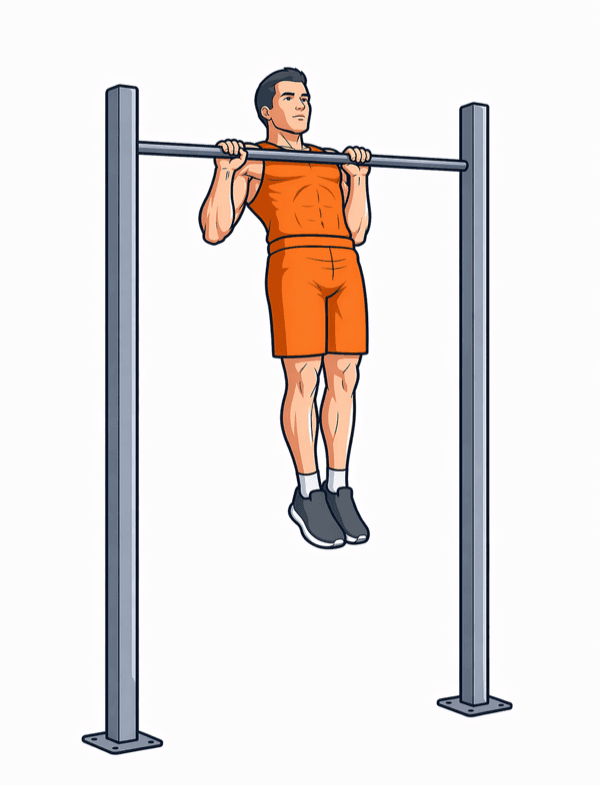
How to do pull-ups properly: technique, mistakes & progression
From the dead hang via scapula and band pull-ups to a clean full-range rep: technique, common mistakes and the complete progression ladder from the Strive Up skill tree.
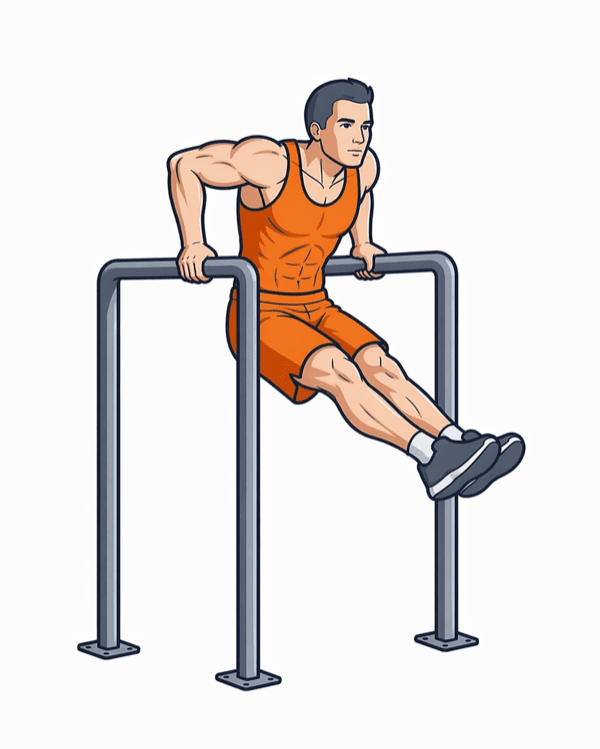
How to do dips properly: from the bench dip to muscle-up ready
The complete dip progression: bench, parallel bars, straight bar, russian. Technique, common mistakes and a training plan – straight from the Strive Up skill tree.
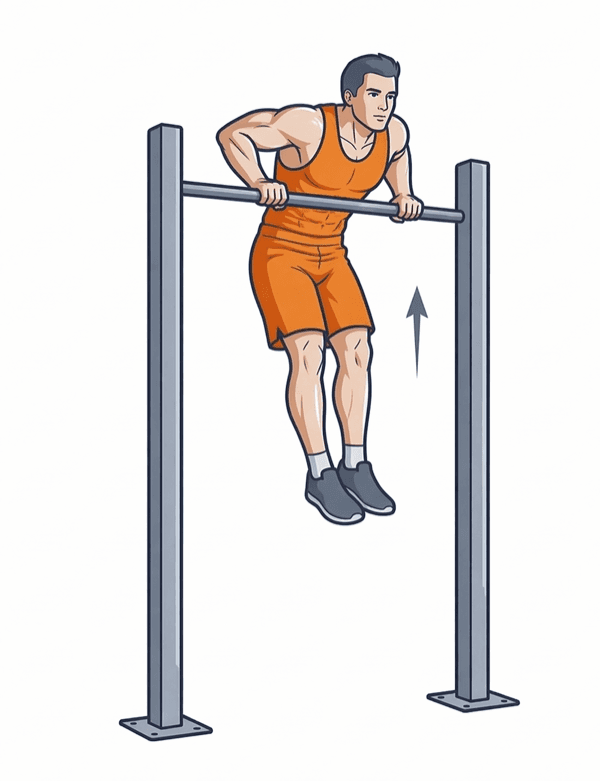
Straight bar dips: the muscle-up bridge on a straight bar
Dips on a straight bar instead of parallel bars – harder than they look and essential for the muscle up. Technique, prerequisites and progression from the Strive Up skill tree.